IVDD in Dogs are terrible. Watching a dog suddenly struggle to walk can be some else. I have seen dogs that looks very healthy get paralyzed all of a sudden. One minute your dog is running around the house, jumping on the sofa, or following you everywhere. Then you notice something different. Your dog is moving slowly, refusing to climb stairs, crying when picked up, walking strangely, or dragging a back leg. Whenever you notice this kind of situation, the cause is usually IVDD in Dogs, short for intervertebral disc disease.
It usually affects the discs between the bones of the spine. When one of these discs degenerates or ruptures, it can put pressure on the spinal cord or nearby nerves. Depending on the location and severity of the problem, a dog may experience anything from back or neck pain to weakness, difficulty walking, paralysis, and problems urinating.
The part many dog owners do not realize is that IVDD in Dogs does not always begin with dramatic paralysis. Sometimes the first clue is simply that your dog no longer wants to jump onto the bed. They gradually get slower until unable to move.
All this and more are we will are going to discus in this article. Makes sure you read to the end.
You can also check
Dog Collar Size Guide: How to Measure Your Dog and Choose the Perfect Fit
BOSS Dog Essentials Adjustable Leash: Features, Size, Uses & What to Know Before Buying
Boss Dog Tactical Dog Leash Review: Everything You Need to Know Before Buying
What Is IVDD in Dogs?
Intervertebral disc disease is a condition affecting the discs located between the vertebrae of a dog’s spine.
Think of the spine as a chain of small bones with cushions between them.
Those cushions are the intervertebral discs.
A healthy disc helps absorb shock and allows the spine to move. Each disc contains a softer central material surrounded by a tougher outer ring. When the disc degenerates, material can bulge or rupture and press against the spinal cord or spinal nerves.
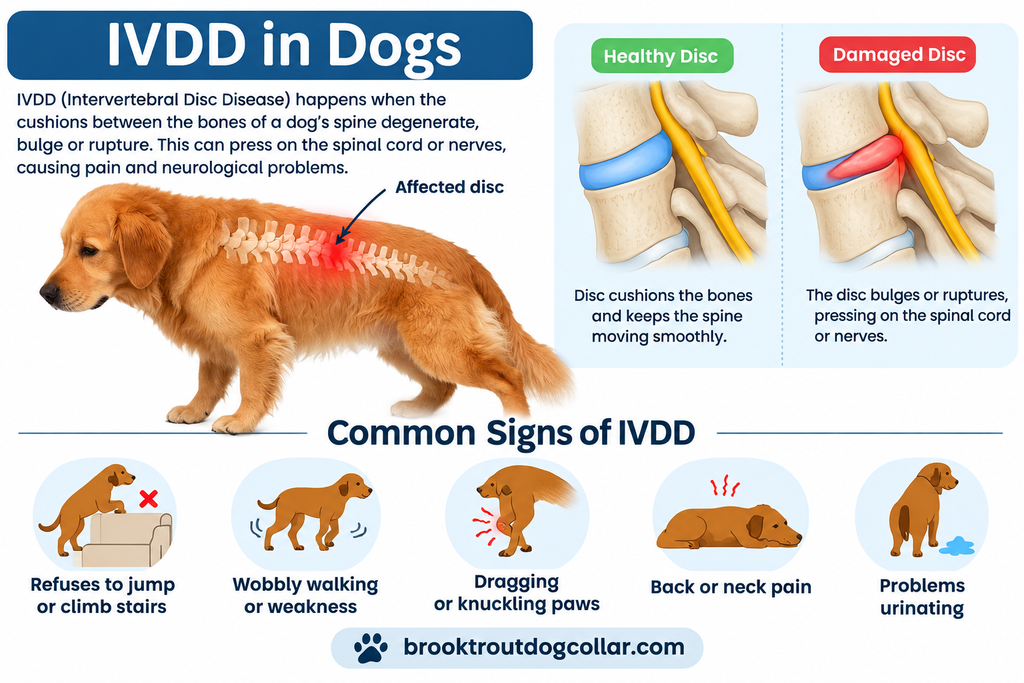
That pressure is what can create the neurological problems owners notice.
Depending on where the affected disc is located, a dog may develop:
- Neck pain
- Back pain
- Muscle spasms
- Stiffness
- Reluctance to move
- Weakness
- An abnormal or wobbly walk
- Dragging or knuckling of the paws
- Difficulty standing
- Partial paralysis
- Complete paralysis
- Problems urinating or defecating
The severity is not determined simply by how painful the dog looks. The amount and location of spinal cord compression, how quickly the problem developed, and the neurological function that remains can all influence the situation. For dog products and care check our list of dog accessories
The Two Words Every Dog Owner Should Understand: Pain and Neurology
One of the most useful ways to think about IVDD is to separate the problem into two major concerns.
1. Pain
A dog with IVDD may appear uncomfortable without initially showing obvious neurological weakness.
You might notice your dog:
- Refusing to jump
- Avoiding stairs
- Crying when lifted
- Holding the head unusually low
- Becoming reluctant to move
- Hiding
- Shivering
- Sitting or lying down more than usual
- Becoming unusually quiet
A dog does not have to be paralyzed to have a significant disc problem.
2. Neurological changes
This is where the situation can become much more serious.
The spinal cord carries signals between the brain and the rest of the body. If disc material significantly compresses the spinal cord, those signals can become impaired.
You may notice:
- Wobbly walking
- Weak hind legs
- Crossing the back legs
- Paw dragging
- Knuckling
- Difficulty standing
- Falling
- Inability to walk
- Paralysis
A rapidly worsening neurological condition deserves urgent veterinary attention.
Why Does IVDD in Dogs Happen?
IVDD in Dogs is a degeneration of the intervertebral discs in dogs. The disease does not look exactly the same in every dog.
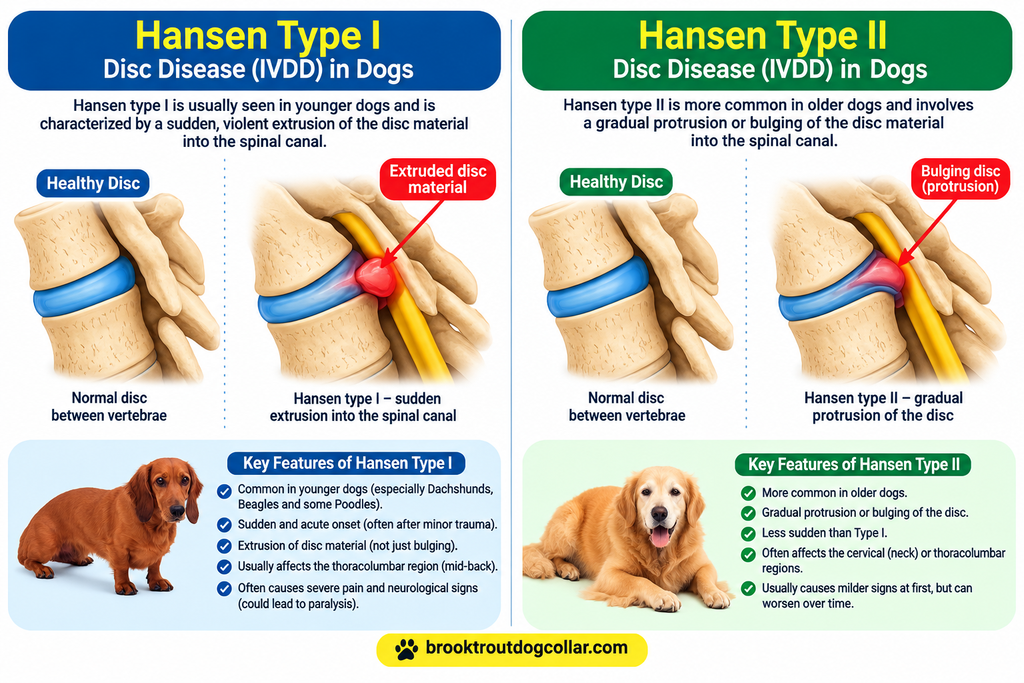
In some dogs, the disc can degenerate and suddenly rupture. In others, disc material may gradually bulge and cause ongoing compression.
Veterinary sources commonly describe two patterns as Hansen type I and Hansen type II disc disease.
Hansen type I is particularly associated with acute disc extrusion and is common in dogs with certain body conformations, while Hansen type II generally involves more gradual disc protrusion and is more commonly recognized in older, larger dogs. Take a look at the image bellow:
The important point for an owner is simple:
IVDD can develop gradually or appear suddenly.
That is why a dog that seemed perfectly normal yesterday can sometimes experience a dramatic change today.
Early Signs of IVDD in Dogs
If your not observant the early signs can be easy to miss.
This is probably one of the most important sections of this entire article because recognizing a problem early gives you a better opportunity to get your dog evaluated before neurological function deteriorates.
Watch for changes such as:
Your dog suddenly stops jumping
If your dog normally jumps onto the couch but suddenly refuses, do not automatically assume it is stubbornness.
Pain can change behavior.
Your dog avoids stairs
A dog with spinal pain may hesitate before going up or down stairs.
Your dog cries when picked up
Some dogs with neck or back pain become uncomfortable when their spine is moved.
Your dog’s walking changes
A slightly wobbly gait can be an important neurological clue.
Your dog holds its head differently
Dogs with cervical disc disease may carry the head lower than normal because neck movement hurts.
Your dog becomes unusually quiet
Pain does not always produce crying. Some dogs simply become less active.
Your dog starts dragging a paw
This is more concerning because it may indicate neurological dysfunction.
Your dog struggles to stand
Difficulty rising can indicate significant weakness or pain and should be evaluated.
The lesson is simple:
Do not wait for paralysis before taking spinal symptoms seriously.
How Does IVDD in Dogs Look Like When It Gets Worse?
As neurological dysfunction progresses, signs can become increasingly obvious.
A dog may progress from pain to:
- Unwillingness to move
- Abnormal walking
- Wobbling
- Weakness
- Difficulty standing
- Inability to walk
- Paralysis
- Loss of sensation in severe cases
Veterinary references commonly describe clinical stages ranging from pain through increasingly severe neurological impairment. The exact classification and treatment decision should be made by a veterinarian based on a neurological examination rather than by an owner trying to assign a stage at home.
How Is IVDD in Dogs Diagnosed?
A veterinarian does not diagnose IVDD simply by looking at a dog’s walk.
The diagnostic process usually starts with the dog’s history and a physical and neurological examination.
Your veterinarian may want to know:
- When did the symptoms begin?
- Did they appear suddenly or gradually?
- Did your dog experience trauma?
- Can your dog walk?
- Is your dog painful?
- Can your dog urinate normally?
- Has your dog had similar episodes before?
- Has the condition been getting better or worse?
The neurological examination helps the veterinarian identify where along the nervous system the problem may be located.
What about X-rays?
X-rays can be useful for evaluating the spine and ruling out or identifying certain problems, but they do not provide the same level of information about the spinal cord and disc material as advanced imaging.
MRI and other advanced imaging
MRI is commonly used when detailed evaluation of the spinal cord and discs is needed, particularly when surgery is being considered. Advanced imaging can help identify the affected disc and determine the source of spinal cord compression.
IVDD in Dogs Treatment: Does Every Dog Need Surgery?
No.
This is one of the biggest misconceptions surrounding IVDD.
Treatment depends on factors such as:
- Severity of neurological signs
- Degree of pain
- Whether the dog can walk
- Whether symptoms are getting worse
- Whether the dog has experienced previous episodes
- The location of the disc problem
- Findings from neurological examination and imaging
Some dogs with less severe disease can be managed conservatively.
Others, particularly dogs with severe or progressive neurological dysfunction, may be candidates for surgery.
The decision should be made with a veterinarian, and in serious cases a veterinary neurologist or specialist surgeon may be involved.
Conservative Treatment for IVDD in Dogs
When appropriate, conservative management can involve several components.
Strict activity restriction
This is often one of the most important parts of conservative treatment. A dog may feel better after a few days of medication and immediately want to run around again.
That can be a problem.
Pain relief can make a dog feel better before the underlying spinal structures have adequately recovered.
Veterinary consensus recommendations emphasize restricted activity for appropriate conservatively managed dogs, with gradual increases in activity later in recovery.
Your veterinarian should determine the exact duration and progression.
Pain management
Veterinarians may prescribe medications to control pain and inflammation.
Depending on the individual dog and the clinical situation, treatment can involve medications such as an NSAID, drugs for neuropathic pain, or muscle relaxants.
Do not give your dog human pain medication unless your veterinarian specifically tells you to.
Some human medications can be dangerous to dogs, and combining medications without veterinary guidance can create serious complications.
Rehabilitation
Physical rehabilitation can become an important part of recovery.
Depending on the dog’s condition, rehabilitation may involve professionally guided exercises, passive range-of-motion work, massage, hydrotherapy, and other techniques.
The ACVIM consensus recommendations support rehabilitation as an adjunct in appropriate cases but emphasize that it should not be viewed as a substitute for necessary surgical management in dogs that require decompression.
Does IVDD in Dogs Surgery Guarantee Recovery?
No surgery can honestly come with a universal guarantee.
The outcome depends heavily on the dog’s neurological status, the severity and location of the spinal cord injury, how long severe dysfunction has been present, and other individual factors.
That is why veterinary assessment is so important.
Two dogs can both be described as having IVDD but have very different neurological conditions and therefore very different treatment plans.
A veterinarian may use the neurological examination and advanced imaging to determine what is happening and whether surgery is appropriate.
What Is IVDD in Dogs Recovery Like?
Recovery is often slower than owners expect. This is where patience becomes part of treatment. Your dog may begin looking better before it is ready to return to normal activity.
During recovery, your veterinarian may recommend:
- Strict rest
- Controlled movement
- Medication
- Harness use
- Rehabilitation
- Assistance standing or walking
- Monitoring urination
- Gradual return to exercise
For cervical disc disease, VCA recommends a harness rather than attaching a leash to a neck collar, particularly because neck movement can aggravate the area.
How To Care for a Dog With IVDD at Home?
Your home environment becomes part of the recovery plan.
Create a safe resting area
Your dog needs a comfortable place where movement can be controlled.
Reduce slippery surfaces
Smooth floors can make walking difficult for a weak dog.
Non-slip rugs or mats can provide better traction.
Prevent jumping
Block access to sofas, beds, stairs, and other places where your dog may attempt to jump.
Use a harness when recommended
For dogs with cervical disease, a harness may reduce pressure on the neck compared with attaching a leash to a collar.
Follow medication instructions exactly
Do not change doses because your dog appears better.
Do not add another medication without checking with the veterinarian.
Monitor your dog’s bathroom habits
Changes in the ability to urinate or defecate can be clinically important in dogs with spinal disease.
If your dog cannot urinate normally or you are unsure whether the bladder is being emptied, contact your veterinarian promptly.
Can IVDD Come Back?
Yes.
Recurrence is possible.
Dogs that have experienced one episode may develop another episode later, particularly when underlying disc degeneration remains.
The ACVIM consensus recommendations specifically note that recurrence should be considered when deciding between conservative and surgical management in appropriate dogs.
That does not mean every dog will have another episode.
It means owners should continue paying attention to changes in movement and pain even after a successful recovery.
Can You Prevent IVDD?
Unfortunately, there is no guaranteed way to prevent IVDD. Some dogs have an inherent susceptibility to disc degeneration, and body structure and genetics can contribute to risk.
However, you can take sensible steps to reduce unnecessary strain and support your dog’s overall health.
These may include:
- Keeping your dog at a healthy weight
- Limiting repeated high-impact jumping
- Preventing uncontrolled stair activity when appropriate
- Using ramps where practical
- Providing good traction on slippery floors
- Using a harness when recommended
- Keeping your dog physically fit through appropriate exercise
- Following veterinary advice if your dog has already experienced IVDD
Weight management deserves particular attention because excess body weight can add mechanical stress to the musculoskeletal system.
What About Dog Ramps?
A ramp can be useful for some dogs with spinal problems because it can reduce the need to jump.
For example, instead of allowing a dog to repeatedly jump out of a vehicle, a properly designed ramp can provide a controlled route to the ground.
The same idea can apply to furniture if your veterinarian allows access. However, a ramp is not a treatment for IVDD. And during strict rest, your veterinarian may recommend that your dog avoid these activities altogether.
IVDD and Dog Beds: Does the Bed Matter?
A comfortable, supportive resting surface can make recovery easier, but buying an expensive bed will not cure IVDD.
What matters most is providing a safe resting environment that allows your dog to remain comfortable without encouraging unnecessary movement.
For a dog on strict rest, the best bed is one that:
- Is easy to enter and exit
- Provides adequate support
- Is large enough to lie comfortably
- Is easy to keep clean
- Does not encourage jumping
- Can be placed in a quiet, controlled area
If your dog has difficulty changing position, ask your veterinarian or rehabilitation professional how the resting setup should be modified.
IVDD vs Arthritis: How Can You Tell the Difference?
This can be confusing.
Both IVDD and arthritis can cause:
- Reduced activity
- Difficulty standing
- Reluctance to climb stairs
- Difficulty jumping
- Stiffness
- Changes in walking
But IVDD can involve spinal cord or nerve compression and may produce neurological signs such as wobbling, paw dragging, weakness, and paralysis.
That is why you should not automatically assume that an older dog who suddenly walks strangely simply has arthritis.
A veterinary examination can help distinguish between different possible causes.
What Should You Do If You Suspect IVDD?
Start with one rule:
Do not test your dog’s limits.
If your dog suddenly refuses to walk, do not encourage it to run around to “see if it gets better.”
If your dog is painful, avoid repeatedly bending or manipulating the spine.
If your dog cannot walk, minimize unnecessary movement while arranging veterinary care.
If you need to transport your dog, ask the veterinary team how they want you to handle the situation. A dog with suspected spinal injury should be moved carefully to avoid unnecessary spinal movement.
10 IVDD Warning Signs Dog Owners Should Never Ignore
Here is the quick-reference version.
Sudden back or neck pain
Your dog suddenly cries, stiffens, or reacts painfully when moving.
Refusal to jump
A previously active dog suddenly avoids furniture or vehicles.
Difficulty climbing stairs
This can be an early sign of pain or weakness.
Wobbly walking
A dog that suddenly looks unsteady deserves veterinary attention.
Paw dragging
Dragging or knuckling can indicate neurological dysfunction.
Weak back legs
Difficulty supporting the hindquarters can be a serious sign.
Trouble standing
A dog that cannot rise normally should be evaluated.
Sudden inability to walk
Treat this as an emergency.
Paralysis
Immediate veterinary assessment is necessary.
Changes in urination
Problems urinating can accompany serious spinal dysfunction and should be reported to your veterinarian.
Questions to Ask Your Veterinarian About IVDD
If your dog has been diagnosed with IVDD, do not leave the clinic without understanding the treatment plan.
Ask:
- Where is the affected disc?
- How severe is the neurological impairment?
- Is my dog considered stable?
- Does my dog need advanced imaging?
- Is conservative management appropriate?
- What would make surgery necessary?
- How much activity is allowed?
- How long should strict rest continue?
- What signs mean I should return immediately?
- How should I help my dog urinate and move safely if necessary?
- When should rehabilitation begin?
- How should exercise be increased during recovery?
- What can I do to reduce the risk of another episode?
These questions can make a stressful diagnosis much easier to understand.
The Biggest Mistake Owners Make With IVDD
If I had to highlight one mistake, it would be this:
Assuming that feeling better means being healed.
A dog may receive pain medication, become more comfortable, and immediately start acting like its old self. That can tempt an owner to allow normal activity again.
But pain relief and spinal recovery are not necessarily the same thing.
This is why following the veterinarian’s activity restrictions is so important. Your dog may need to be bored for a while. That is frustrating.
But controlled recovery can be much safer than allowing an enthusiastic dog to sprint around the house simply because it appears happier.
Also Check
Dog Collar Size Guide: How to Measure Your Dog and Choose the Perfect Fit
BOSS Dog Essentials Adjustable Leash: Features, Size, Uses & What to Know Before Buying
Boss Dog Tactical Dog Leash Review: Everything You Need to Know Before Buying
Dogline Biothane Waterproof Dog Leash Review: Is It Actually Worth Buying?
Bowsers Oslo Ortho Dog Bed Review: Sizes, Comfort, Pros, Cons & What to Know Before Buying




Leave a Reply